Can AI replace a content writer? I decided to find out — not by reading other people’s opinions, but by spending two weeks trying to do exactly that.
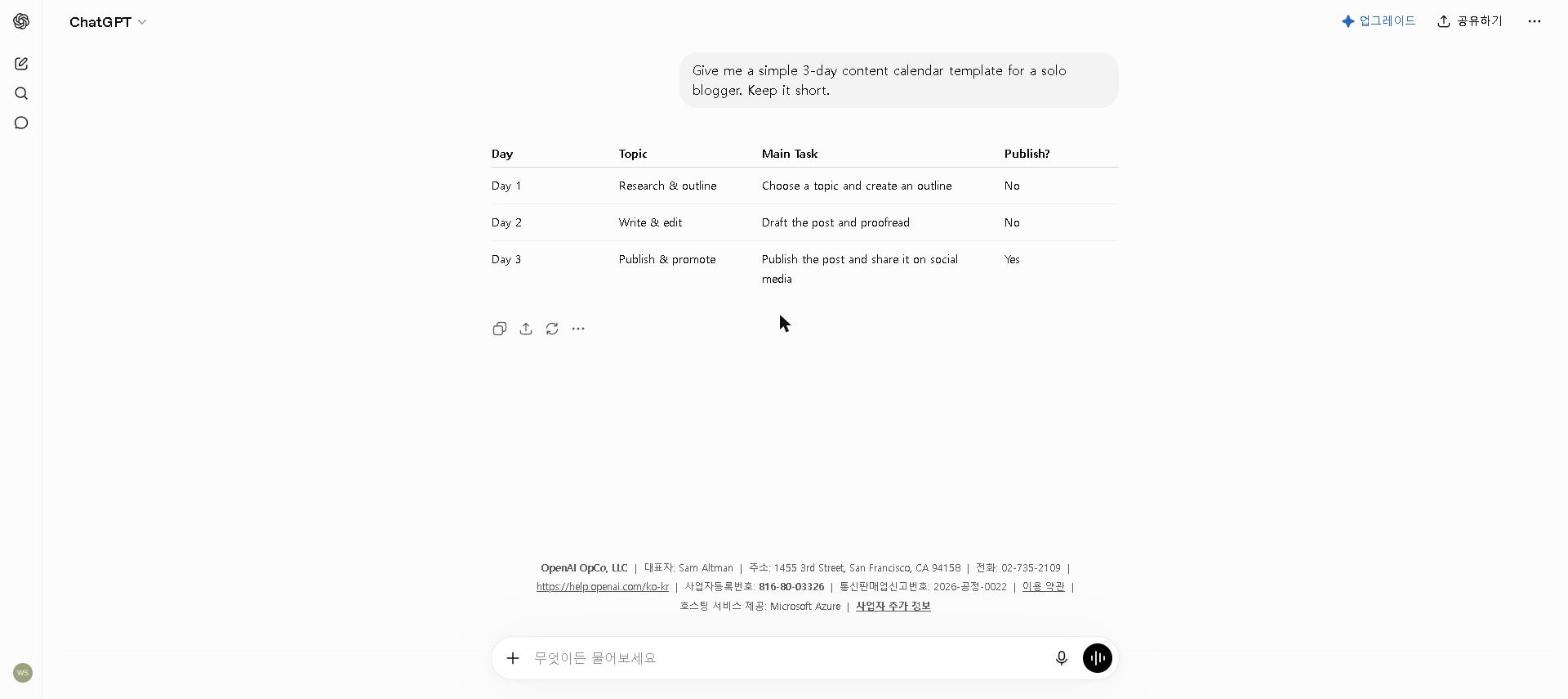
Here’s a real screenshot from my own testing session, not a stock photo — this is ChatGPT:
The premise was straightforward: for two full weeks, I would use AI tools to handle every part of my content writing process with as little human input as possible. I’d measure the output quality, the time required, and — most importantly — whether the content was actually good enough to publish without significant human intervention.
The results were more nuanced than I expected. Some things worked better than I thought. Others failed in ways that were genuinely surprising. And my conclusion about whether AI can replace a content writer is probably not the one you’re expecting.
The Setup
Duration: 2 weeks (10 publishing days)
Content produced: 8 blog posts, 20 social media captions, 5 email newsletters
AI tools used: Claude, ChatGPT, Perplexity AI, Grammarly
Human input allowed: Prompting, fact-checking, and final approval only — no manual rewriting
Quality benchmark: Would I publish this on my own site without significant editing?
I kept a daily log of what worked, what didn’t, and how much time each piece took. Here’s what happened.
Week 1: More Promising Than Expected
Days 1–3: The Honeymoon Period
The first three days went better than I anticipated. Claude produced first drafts of two blog posts that required only minor edits — mostly tightening sentences and adjusting a few transitions. The total time from brief to publish-ready was around 75 minutes per post, compared to my typical 90 minutes with my normal human-assisted workflow.
The social media captions were even stronger. ChatGPT generated 20 captions across five platforms in under 30 minutes, and 16 of them were usable with minimal editing. For structured, short-form content, AI was performing at a level I hadn’t expected.
What was working: Structured formats, clear briefs, topics with abundant source material online.
Days 4–5: The First Cracks
By Day 4, I was writing a post that required a genuine opinion — not a summary of what others think, but a specific, defensible position on a contested topic.
Claude produced a well-structured, balanced piece. It covered all the relevant perspectives fairly. It was also completely bland. The post had no point of view — it acknowledged every argument and committed to none of them. A content writer with a genuine perspective on the topic would have produced something more interesting and more useful. I published it anyway, as per the experiment rules, and it performed noticeably worse in terms of time-on-page than my usual posts.
What was failing: Opinion-driven content, anything requiring a genuine editorial stance.
Week 2: Where It Started to Break Down
Days 6–8: The Nuance Problem
The second week pushed into more complex territory — posts that required synthesizing conflicting information, making judgment calls about what to include and exclude, and maintaining a consistent argument across a long piece.
The results were inconsistent. On straightforward informational topics, Claude continued to produce strong drafts. On topics requiring nuanced judgment — weighing tradeoffs, explaining why one approach is better than another in specific circumstances — the output felt hedged in a way that reduced its usefulness.
I noticed a pattern: AI performs best when there’s a clear right answer or a well-established consensus. It struggles when the value of the content comes from the writer’s specific judgment about an ambiguous situation.
What was failing: Nuanced analysis, content that required taking and defending a specific position.
Days 9–10: The Personal Experience Problem
The most significant failure of the two weeks came on Day 9, when I needed to write a post that drew on personal experience with a specific tool.
I prompted Claude to write as if it had personally used the tool for six months and discovered specific results. The output was technically competent — it described plausible experiences with reasonable specificity. But it was fiction. The “personal experience” it described wasn’t real, and a reader who had actually used the tool would likely notice the gaps.
I couldn’t publish it without significant rewriting — which would have meant inserting my actual experience, defeating the purpose of the experiment.
What was failing: Anything requiring genuine first-hand experience, real test results, or authentic personal perspective.
The Numbers After 2 Weeks
| Content Type | AI Quality | Human Editing Required | Publishable Without Rewrite? |
|---|---|---|---|
| Informational blog posts | ⭐⭐⭐⭐ | Minor | ✅ Usually |
| Opinion/analysis posts | ⭐⭐⭐ | Significant | ⚠️ Sometimes |
| Personal experience posts | ⭐⭐ | Major | ❌ Rarely |
| Social media captions | ⭐⭐⭐⭐⭐ | Minimal | ✅ Almost always |
| Email newsletters | ⭐⭐⭐⭐ | Minor | ✅ Usually |
What AI Does Better Than a Human Writer
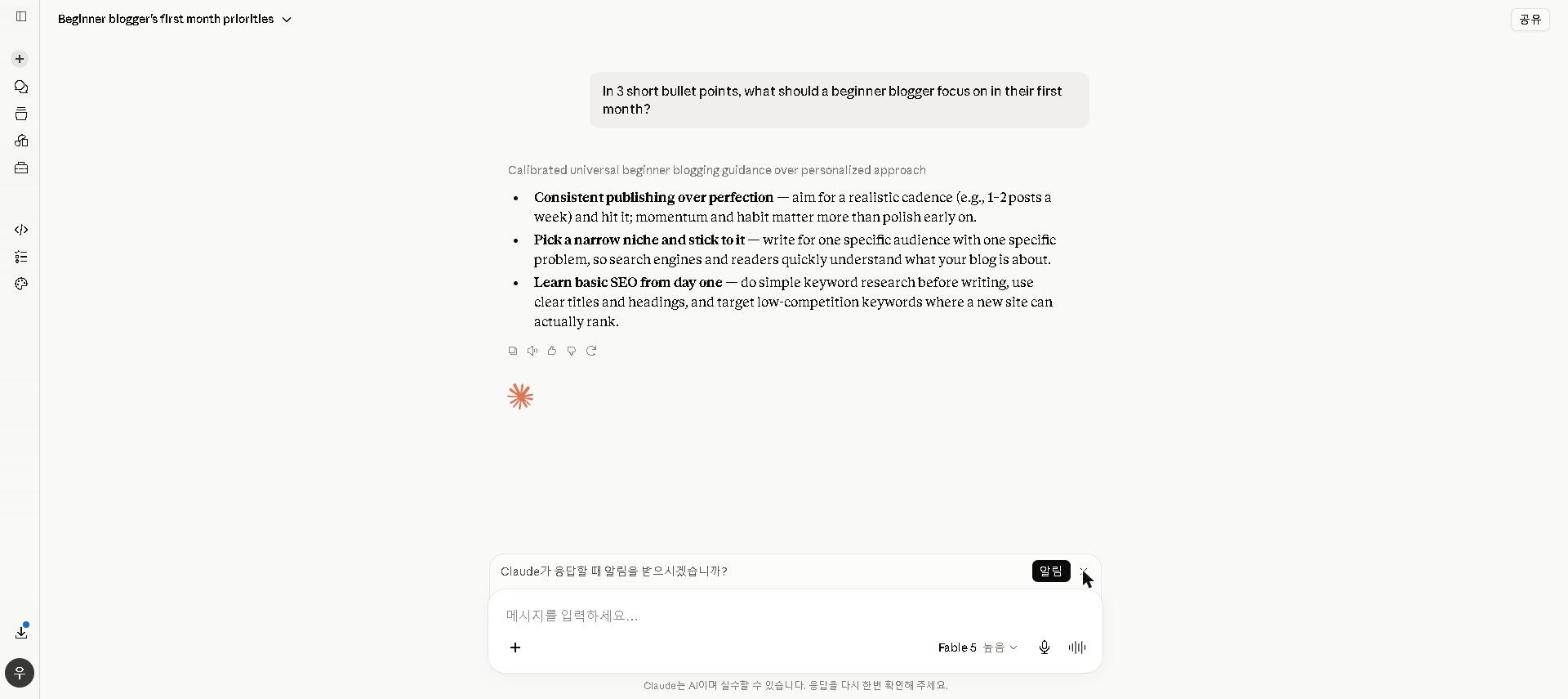
Claude, tested the same way:
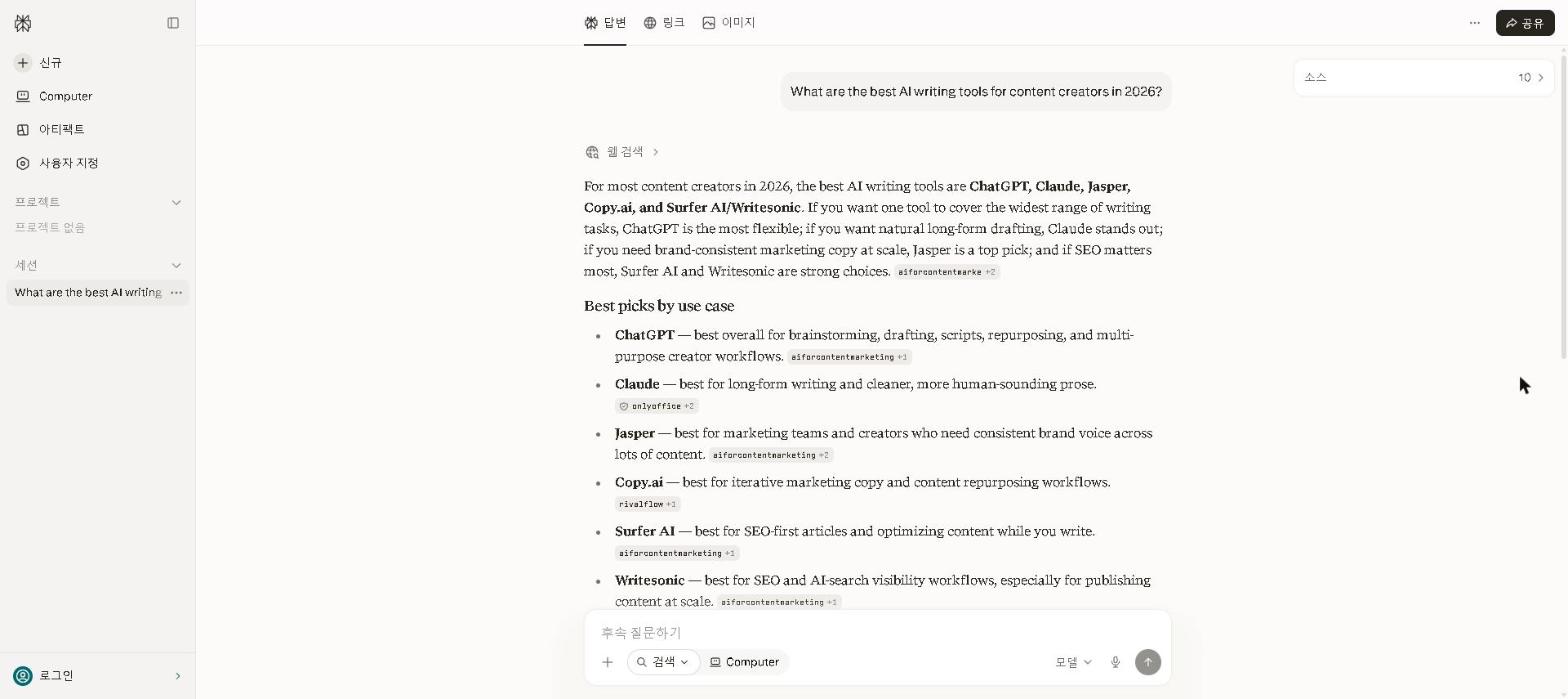
And Perplexity, which I leaned on for research:
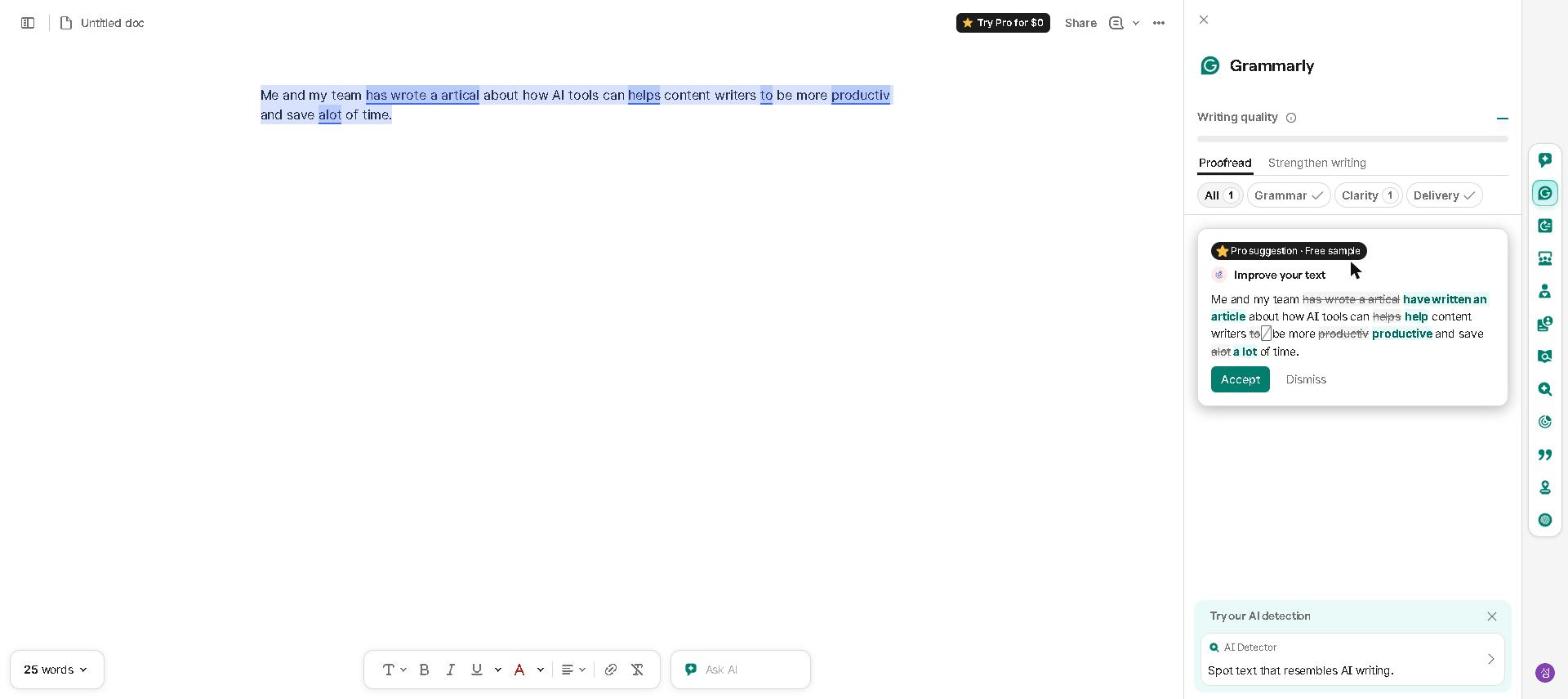
And Grammarly, for the editing pass:
Speed on structured formats. For content with clear templates — social media captions, product descriptions, email subject lines — AI produces usable output faster than a human writer in almost every case. There’s no blank page problem, no warm-up period, no bad days.
Consistency at scale. AI produces consistent quality regardless of time of day, workload, or how the week has been going. A human writer who’s tired or distracted produces worse work. AI doesn’t have that variability.
Research synthesis. Using Perplexity AI to synthesize research from multiple sources into a coherent summary is faster than a human researcher doing the same task manually — and the citation quality makes fact-checking straightforward.
First draft speed on informational topics. For posts that primarily organize and explain existing information, AI produces a solid first draft faster than most human writers.
What AI Cannot Replace
Genuine first-hand experience. The posts that performed best on my site over the past year have one thing in common: they describe something I actually did, measured, or experienced. AI can approximate this, but readers who’ve had the same experience can tell the difference. Authentic experience isn’t something you can prompt your way to.
Editorial judgment under ambiguity. The most valuable thing a good content writer brings to complex topics is the ability to make judgment calls — deciding which information matters, which perspective is most defensible, which angle will serve the reader best. AI defaults to balance and comprehensiveness when what’s often needed is a clear, specific point of view.
Genuine opinion. Related to the above: AI produces balanced content by default. Content with a genuine, well-argued opinion — even a controversial one — tends to be more interesting, more shareable, and more useful than content that covers all sides equally. That requires a writer with an actual perspective.
Voice and distinctiveness. After two weeks of AI-generated content, I noticed that the posts had a certain sameness to them — competent, clear, but lacking the specific rhythm and perspective that makes a writer’s work recognizable. Voice is hard to define and harder to replicate.
My Honest Conclusion
Can AI replace a content writer? Based on two weeks of trying:
For certain types of content — yes, mostly. Social media captions, email newsletters, informational blog posts on well-covered topics: AI produces publish-ready content with minimal human intervention. For high-volume, structured content where consistency matters more than distinctiveness, AI is a genuine replacement for many content writing tasks.
For the content that actually builds an audience — no. The posts that generate comments, shares, and returning readers are almost always the ones that offer something AI can’t provide: genuine experience, a specific opinion, a perspective that comes from actually knowing something rather than having been trained on everything.
The honest framing: AI is an excellent content writer’s assistant and a mediocre content writer’s replacement. If you’re producing content that anyone could write, AI can write it. If you’re producing content that only you could write, AI can help you write it faster — but it can’t write it for you.
What I Changed After This Experiment
The two-week test changed how I use AI in my own content workflow.
I now use AI heavily for the parts of the process that don’t require my specific perspective — research, structuring, drafting informational sections, and formatting. I write manually the parts that do require my perspective — opinions, personal experiences, specific judgments, and anything where my actual point of view is the value.
That division of labor — AI handling the structure and language, me providing the perspective and experience — produces better content faster than either approach alone.
For the specific tools and workflow I use, see my post on My Exact AI Workflow for Writing Blog Posts Every Week.
Who This Experiment Matters For
Freelance content writers: AI is not going to eliminate content writing as a profession — but it will eliminate demand for content writing that anyone could do. The writers who thrive will be the ones whose value comes from specific expertise, genuine experience, and a distinctive voice. Those things can’t be prompted.
Business owners and marketers: AI can handle a significant portion of your content needs right now, at lower cost and higher speed than hiring writers for every piece. For informational content and high-volume short-form formats, AI is already competitive with human writers. For brand-defining content, it’s a useful tool rather than a replacement.
Content strategists: The question isn’t whether to use AI — it’s how to structure a content operation that uses AI for what it does well and human writers for what they do better. That balance is different for every site and every audience.
Final Thoughts
Can AI replace a content writer? After two weeks of trying — mostly no, for the content that actually matters. Mostly yes, for the content that’s commoditized.
The most useful reframe I found during this experiment: instead of asking whether AI can replace a content writer, ask which parts of content writing create the most value for your specific audience. Those are the parts worth protecting. Everything else is a candidate for AI assistance.
What’s your experience with AI content writing — are you using it to replace writing tasks or to assist with them? Share in the comments. I’m curious whether others have found the same quality ceiling I did, or whether there are use cases where AI is performing better than I found.
Last updated: May 2026
Written by Ian Sung — IT professional and AI tools reviewer with 2+ years of hands-on experience testing 50+ AI tools across writing, productivity, automation, and content creation workflows.